Program Calendar
-
Available Dates
Live Virtual Training
-
 06 June, 2026
-
19:00 - 23:00 IST
-
Weekend
Live Virtual Training
-
13 June, 2026
-
19:00 - 23:00 IST
-
Weekend
Live Virtual Training
-
20 June, 2026
-
19:00 - 23:00 IST
-
Weekend
-
 06 June, 2026
 19:00 - 23:00 IST
 Weekend
Course Overview
Enroll to Ansible training provides a fundamentally undemanding IT automation engine that computerizes cloud provisioning, application deployment, configuration management, intra-service orchestration, and needs that are associated with IT.
Key Features
 Job Opportunities
Career Assistance
Lifetime Access to Digital Tutorial
Practical Learning and Networking
Job Opportunities
Career Assistance
Lifetime Access to Digital Tutorial
Practical Learning and NetworkingLearning Objectives
- Ansible assists IT professionals, by automating every execution, which makes the project simple and comprehensive.
- Automation abridged multifaceted tasks, not just creating developers’ jobs more executable but also assisting them to concentrate attention on other errands that add value to an enterprise.
- It respects your business hours by reducing time on execution and influences efficiency.
Why Learn Ansible?
- Agentless automation platform
- Simplifies server configuration
- Automates application deployment
- Supports cloud and hybrid environments
- Widely used in DevOps and Infrastructure as Code (IaC)
Prerequisites
Ansible is widely used by organizations to automate IT operations, improve deployment efficiency, and reduce manual administration tasks. During this training, participants will learn how Ansible is applied in real-world environments for infrastructure management and DevOps automation.
- Linux server provisioning and configuration management
- Automated application deployment across multiple environments
- Cloud infrastructure automation on AWS, Azure, and Google Cloud
- Configuration compliance and system standardization
- CI/CD pipeline automation and DevOps workflows
- Kubernetes and container environment management
Prerequisites
Students are not required to possess coding skills for utilizing Ansible’s playbooks.
Benefits
- Application deployment
- Intra service orchestration
- Configuration management
- Various automation criticalities
Less cost or no cost: The product belongs to an open-source arena, thus every student finds Ansible certification price affordable.
Skills Covered
Ansible Playbooks
Configuration Management
Infrastructure Automation
Server Provisioning
YAML Fundamentals
Inventory Management
Ansible Roles
DevOps Automation
CI/CD Integration
Cloud AutomationCourse Curriculum
-
Topic Covered:
- Why configuration management is a critical part of any DevOps team
- Strengths and weaknesses of Ansible
- Webscale
- How Ansible is different from other CM tools like Chef and Puppet
- Getting started with Ansible terminology
- Ansible and YML for describing your environments
-
Topic Covered:
- Some prerequisites
- Getting set up on a Mac
- Getting set up on Linux
- Getting set up on Windows
- Testing with Vagrant
- Using SSH keys to connect to your target nodes
-
Topic Covered:
- Basic inventory example
- Hosts and groups
-
Topic Covered:
- A useful directory structure to keep your Ansible code organized
- Using git to manage your Ansible code
- A first look at a playbook to install and configure NTP time synchronization
-
Topic Covered:
- Connecting Ansible to your preferred cloud provider (we’ll use DigitalOcean)
- Creating a new server instance
- Dynamic inventory
- Dynamic inventory on Amazon AWS
- Mixing static and dynamic inventory
-
Topic Covered:
- Spec up our inventory and host groups
- Using roles
- Configure our database backend
- Configure our web server front-end
- Configure a replicated filesystem
- Configure centralized logging
-
Topic Covered:
- Deploying our app from SCM to our local Vagrant environment
- How we would deploy that code to production once tested by QA
- Updating our application
- How Ansible compares to alternatives such as Capistrano
-
Topic Covered:
- A brief intro to Docker
- The synergy of containerization and automation
- Using Ansible to build Docker containers
- MySQL containers
- Web application containers
- Data storage containers
-
Topic Covered:
- Unit, integration and functional testing
- Automating your testing using GitHub and Travis CI
-
Topic Covered:
- Real-world use case: Using Ansible to automate CM and application pipelines through continuous integration, release, deployment, and operations
- We’ll review your own environments and processes and evaluate how to best integrate Ansible’s configuration management for your own needs
+91 8447121833
Available 24x7 for your queries
Related training Courses
FAQs
Training Features

Experiential Workshops
Top-rated instructors imparting in-depth training, hands-on exercises with high energy workshop

Certificate Exam Application Assistance
The training program includes several lab assignments, developed as per real industry scenarios.

Certificate Exam Success Formula
Training begins taking a fresh approach from basic, unique modules, flexible, and enjoyable.

Certificate Journey Support
Basic to intermediate and eventually advanced practicing full hands-on lab exercises till you master.

Free Refresh Course
Refresh training for experts for mastering and enhancing the skills on the subjects with fresh course modules.

Exclusive Post-Training Sessions
Includes evaluation, feedback, and tips to handle critical issues in live setup after you are placed in a job.
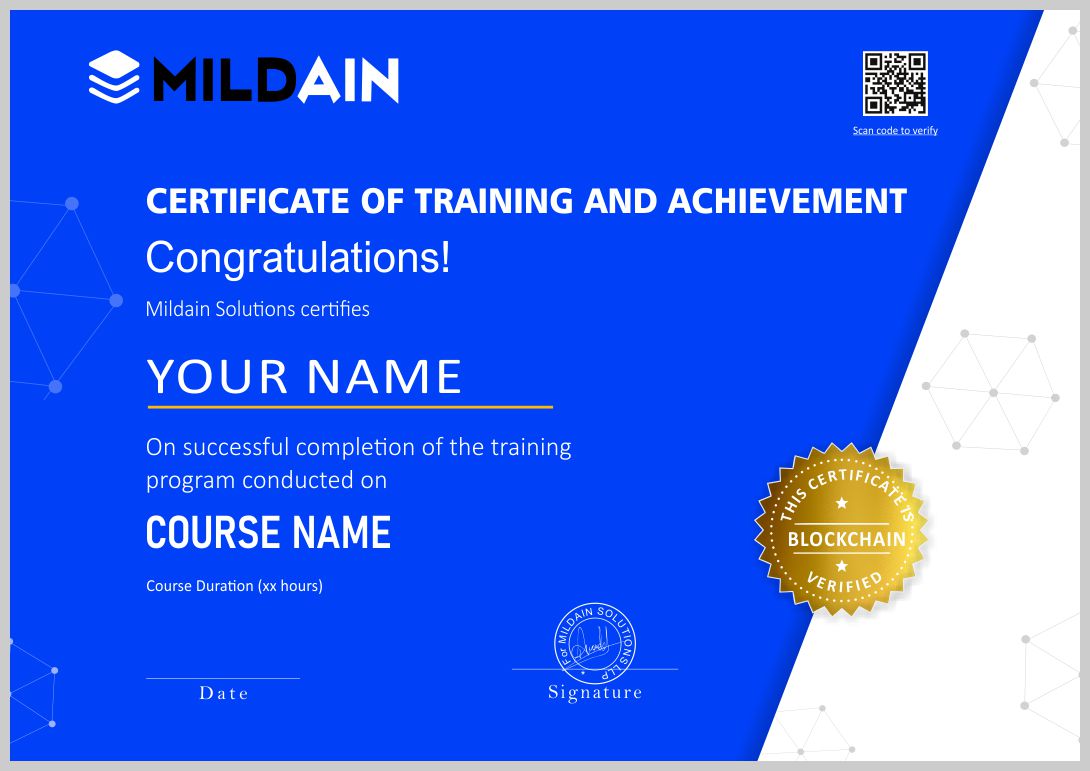
Mildain's Master Certificate
Earn your certificate
This certificate proves that you have taken a big leap in mastering the domain comprehensively.
Differentiate yourself with a Masters Certificate
Now you are equipped with real-industry knowledge, required skills, and hands-on experience to stay ahead of the competition.
Share your achievement
Post the certificate on LinkedIn and job sites to boost your profile. Notify your friends and colleagues by sharing it on Twitter and Facebook.